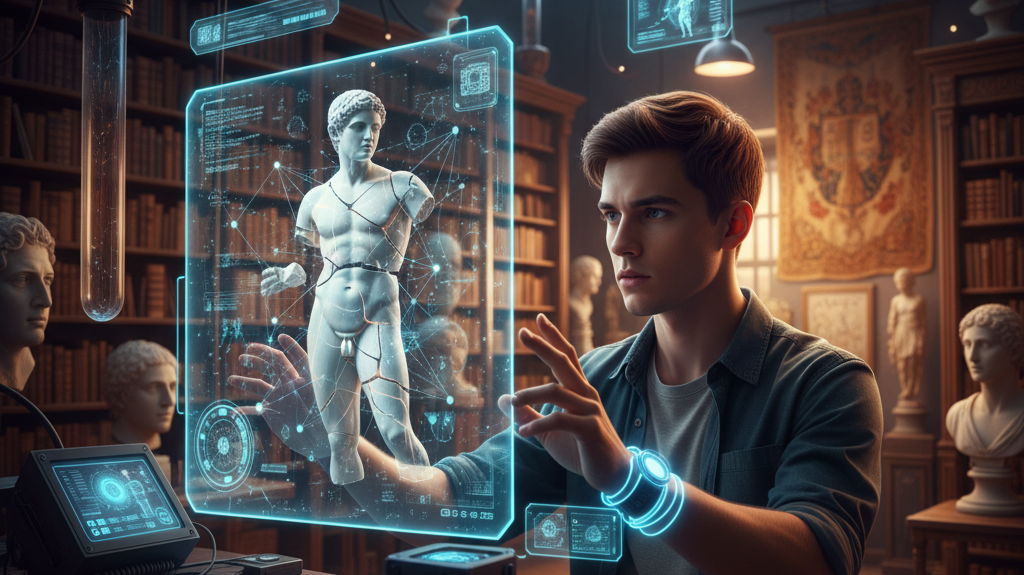
AI & Antiquity: A Student Reshaping Art Restoration
When I read the news about a high schooler developing an AI tool for ancient art restoration, my immediate thought was: ‘This is why I love my job.’ Every now and then, amidst the relentless stream of innovations and announcements, a story emerges that not only captures attention but reinvigorates our faith in human and technological potential. From my perspective here at Cortex News, it’s not just about analyzing the latest trends, but also about celebrating those sparks of genius that define progress. This isn’t merely a story about artificial intelligence; it’s a tale of passion, vision, and the ability of a single mind to look beyond conventional boundaries, demonstrating an ambition and innovation that command our full attention.
Bridging Youthful Genius and Artificial Intelligence
The story I’m referring to involves a student—a brilliant young mind who chose to tackle a seemingly massive challenge: how to preserve ancient art, often degraded by time and events. Immersed as I am in the tech world, I never cease to be amazed at how new generations, often with limited resources but unwavering determination, manage to think ‘outside the box.’ Their journey, likely filled with countless hours studying algorithms and testing models, is proof that age is no barrier to innovation. They understood that AI isn’t just for Silicon Valley giants, but serves as a democratic tool accessible to anyone with the curiosity and drive to explore, turning technology into a means for a noble end.
Behind the Scenes: The Tech Saving the Past
Let’s get to the heart of the matter: how does this tool work? From my analytical standpoint, we are looking at an ingenious application of machine learning, likely built on generative neural networks or deep learning techniques. The underlying idea is to train an algorithm on a vast dataset of intact and damaged artworks. The AI thus learns patterns, styles, textures, and symmetries, enabling it to ‘predict’ how a missing or deteriorated part of an artwork *should* look. Imagine an algorithm that not only fills in the gaps of a faded fresco or a fragmented statue, but does so with a stylistic coherence that a human eye—no matter how expert—would take hours, days, or even months to replicate. This isn’t mere photographic manipulation; it’s an intelligent reconstruction based on a profound analysis of the artwork’s artistic and historical context.
The Revolutionary Impact on Art and Culture
The potential impact of such a tool is, in my view, immense. Traditional restoration is a delicate, expensive, and time-consuming art, often involving irreversible processes. The digital approach offered by this AI allows us to explore virtual restoration scenarios without ever touching the original. This means conservators and art historians gain a powerful ally to visualize the past, better understand works in their original state, and plan more informed physical interventions. I have always believed that technology should serve humanity in every aspect, and the preservation of cultural heritage is one of its noblest arenas. This project not only helps preserve the beauty of the past but also makes it more accessible to future generations, allowing us to connect more deeply with our collective history.
In my opinion, stories like that of this young innovator are not just fascinating, but essential. They remind us that technology isn’t some abstract entity, but a potent instrument in the hands of those with the vision to wield it. They show us that innovation can stem from anywhere—even a school desk—and that the new generations are not only digital natives but are fully capable of shaping our future with astonishing awareness and creativity. Their work not only promises to preserve fragments of our past but also inspires an entire generation to look forward with fresh eyes. It is a striking demonstration of how curiosity and determination can bridge seemingly distant worlds, like high tech and millennia-old art. And you, readers of Cortex News, what impact do you think AI will have on cultural heritage conservation in the coming years? I’m eager to read your thoughts.
Architecture platforms and hardware vetted by our editorial team for deploying scalable models and automated workflows:
- Compute & GPU Clusters: Benchmark scalable inference and fine-tuning on Runpod Cloud GPUs ($5 free setup credits).
- Workflow Automation & Agent Pipelines: Orchestrate autonomous workflows on Make.com Enterprise Automation (1 month Core plan free + 10,000 credits).
- Enterprise AI Hardware & Workstations: Procure certified developer gear and RTX/deep learning accelerators on Amazon Enterprise Tech Store.
