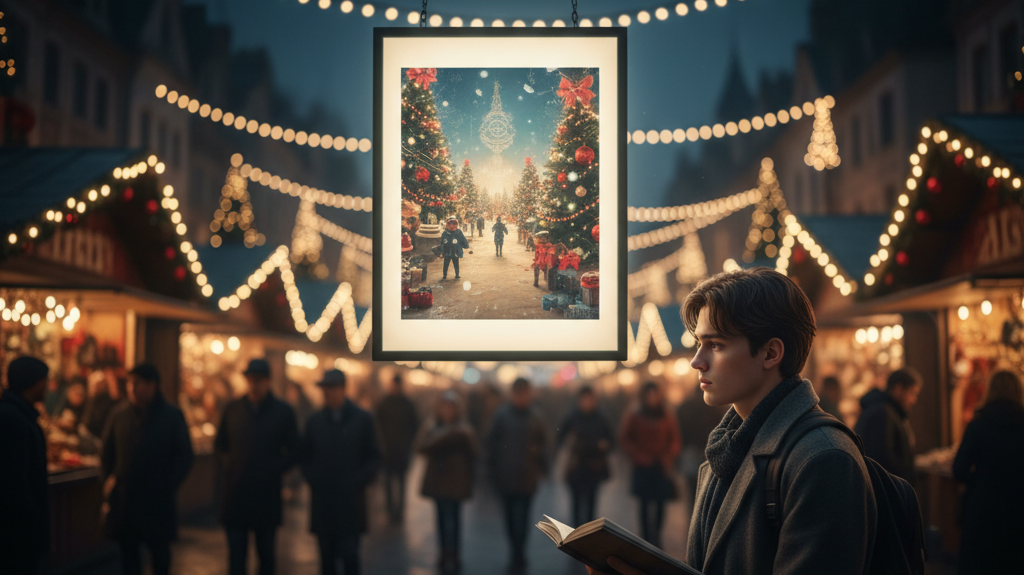
AI & Christmas Art: The Poster Igniting the Digital Creativity Debate
When I read the news about a Christmas poster that ignited a fierce discussion on the use of artificial intelligence, my mind immediately went to the core of the debate that has been energizing the tech and creative sectors for months. In my view, this is not a mere local episode; rather, it serves as a magnifying glass for much broader issues concerning authenticity, the value of human art, and the future of design in the digital age. Hailing from a holiday event, this story bridges tradition with cutting-edge technology, creating a short circuit that demands rigorous analysis.
At the center of the controversy is a promotional poster for the “Christmas Stroll,” a community event that, like many others, relies on visual art to capture attention. However, the chosen image immediately raised suspicions among residents and industry insiders: too many “strange” details, an aesthetic that was slightly too perfect yet subtly inconsistent, drove observers to cry AI. While the organizer attempted to clarify the situation, doubts persisted, turning a simple graphic asset into a symbol of a much larger question: Is it permissible, ethical, or even desirable to delegate creativity to an algorithm?
What is Generative AI and How Does It Work?
In evaluating production workflows, requires clarifying what generative AI actually is—the technology enabling the creation of imagery, text, or music from scratch. Tools like Midjourney, DALL-E 3, or Stable Diffusion rely on complex deep learning models trained on gigantic datasets of existing imagery. When a user inputs a text “prompt,” the AI interprets the request and synthesizes an image matching the description based on its training parameters. It is a process that mimics creativity by drawing upon and reprocessing learned styles and concepts. The output is often breathtaking, yet it frequently bears those digital “fingerprints” that our increasingly trained eyes can easily spot: hands with extra digits, unusual geometries, and dreamlike gradients that betray their non-human origin.
The Root of the Controversy: Authenticity and Artist Impact
The negative backlash does not stem from mere technological “purism.” The issue is deeply multifaceted. First, there is the perceived lack of authenticity. A community event, particularly a holiday gathering, is steeped in local spirit and a human touch that should ideally manifest in its visual representation. Untransparent AI usage can easily be perceived as a shortcut—a “cold” choice that devalues the work of local or traditional artists. Second, we must consider the professional fallout. Many graphic designers and illustrators view generative AI as a direct threat to their livelihood, not just economically, but regarding the dignity of creative labor. The sheer ease of generating high-quality results prompts an uncomfortable question: Why hire an illustrator when software can execute the task in minutes at negligible costs? This fear is entirely grounded, and the Christmas poster debate is merely a small yet telling symptom of this paradigm shift.
The Future of Design and Human Art in the AI Era
This episode forces us to confront the trajectory of design and art. I firmly believe that AI should not be treated as an enemy to combat, but rather as a tool to comprehend and wisely integrate. The crucial question is not “whether” to use AI, but “how.” We desperately need greater transparency: if an image is AI-generated, perhaps that fact should be explicitly disclosed. Furthermore, we must position AI as a co-creator or assistant, rather than a total replacement. Originality, cultural sensitivity, and the intrinsic soul infused by an artist remain utterly irreplaceable. Our challenge is to redefine human roles within the AI era—perhaps evolving into curators, creative directors, or expert “prompters”—shifting our focus from sheer execution to conceptualization and the unique value-add only the human mind can provide.
In my opinion, this Christmas poster case serves as a vital alarm bell that communities and enterprises can no longer afford to ignore. We are dealing not just with aesthetics, but with core values, professional sustainability, and the fundamental identity we want art and design to project into our future. Ignoring these debates means squandering the opportunity to shape a fairer, more creative digital ecosystem. What are your thoughts? Should AI be leveraged for community events like the holidays, or must boundaries be enforced? Where do you draw the line between technological efficiency and human authenticity?
Architecture platforms and hardware vetted by our editorial team for deploying scalable models and automated workflows:
- Compute & GPU Clusters: Benchmark scalable inference and fine-tuning on Runpod Cloud GPUs ($5 free setup credits).
- Workflow Automation & Agent Pipelines: Orchestrate autonomous workflows on Make.com Enterprise Automation (1 month Core plan free + 10,000 credits).
- Enterprise AI Hardware & Workstations: Procure certified developer gear and RTX/deep learning accelerators on Amazon Enterprise Tech Store.
