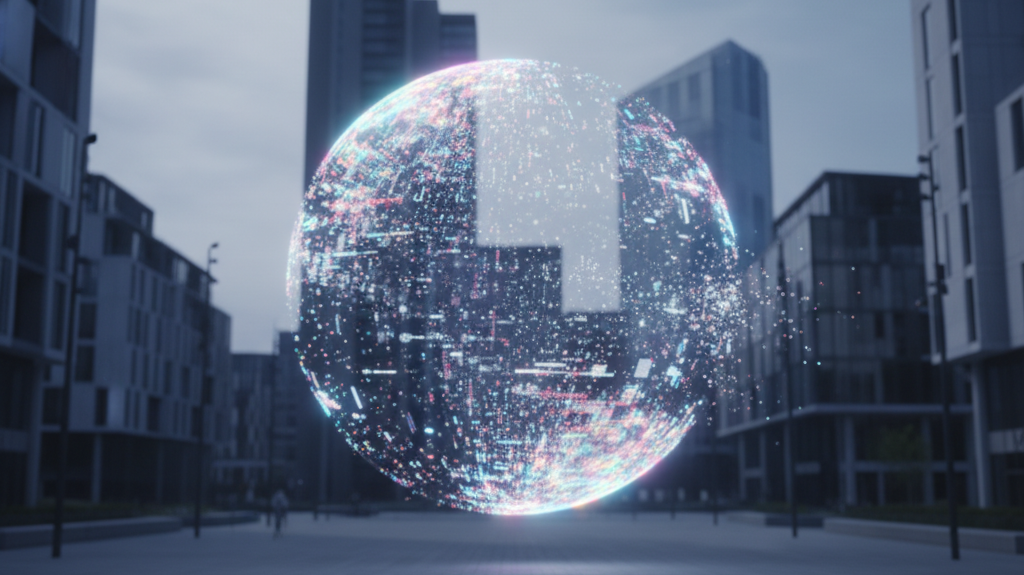
AI Art Suspended: London’s Digital Colossus and Tech Limits
When I read the news about the cancellation of the massive AI-based artwork in London, a touch of disappointment washed over me. Here at Cortex News, we have long followed the evolution of AI not just as a technological tool, but as a creative force capable of redefining the boundaries of human expression. Imagining a dynamic sculpture, generated by algorithms and placed in the heart of an iconic city like London, felt to me like a powerful symbol of this progress. And now, this ambitious project has collided with the harsh reality of facts.
The Shattered Dream: An AI Sculpture for the Capital
While its finer details weren’t always known to the general public, the project promised to be truly groundbreaking. We were talking about a massive installation—a sort of ‘always-on’, continuously evolving sculpture driven by artificial intelligence algorithms. The concept was to create a digital landmark on the Greenwich Peninsula, an artwork that would interact with its surrounding environment and real-time data, offering a unique and constantly shifting visual experience. It was a clear demonstration of AI’s potential to transcend mere computation and embrace creativity on a monumental scale. The vision was bold: an artwork that was never the same, breathing and changing with the flow of time, powered by an artificial mind.
Why Did Such an Ambitious Project Stall?
The primary reason behind the cancellation, as is often the case with ventures of this magnitude, lies in practical and economic challenges. This was not an inherent technological failure of AI, but rather the complexity tied to its implementation and long-term sustainability. An ‘always-on’ AI-generated artwork demands significant computational resources, a robust infrastructure, and constant maintenance. The operational costs, energy requirements, and logistical complexity needed to sustain an installation of this size and dynamism clearly outstripped expectations or funding capabilities. It is the classic collision between technology’s boundless imagination and the concrete limits of the physical world and its resources.
Implications for Art and Technology
This event forces us to reflect on several crucial issues at the intersection of art and technology. First, it sparks a debate on the economic sustainability of large-scale generative art. How much are we willing to invest not just in the initial creation, but in the upkeep and evolution of complex digital artworks? Second, it highlights the need for more realistic planning and innovative business models to support AI-driven artistic visions. Perhaps the future lies not in massive, permanent standalone installations, but in more modular, touring projects, or those finding their ideal environment in the metaverse, where infrastructure costs differ entirely. Finally, it questions the perceived value of AI art: is it viewed as a fleeting attraction or a lasting cultural investment?
In my view, this episode should not be seen as a defeat for generative art, but rather as a valuable lesson. It reminds us that innovation, no matter how brilliant, must always contend with the realities of resources, sustainability, and logistics. The future of AI art is still unwritten, but it will require a more pragmatic and collaborative approach, integrating artistic vision with solid planning. The question I ask myself—and pose to you, our readers—is: are we truly ready to fund and sustain the full grandeur of AI art over the long term, or will it remain a dream confined to research labs due to economic constraints?
Architecture platforms and hardware vetted by our editorial team for deploying scalable models and automated workflows:
- Compute & GPU Clusters: Benchmark scalable inference and fine-tuning on Runpod Cloud GPUs ($5 free setup credits).
- Workflow Automation & Agent Pipelines: Orchestrate autonomous workflows on Make.com Enterprise Automation (1 month Core plan free + 10,000 credits).
- Enterprise AI Hardware & Workstations: Procure certified developer gear and RTX/deep learning accelerators on Amazon Enterprise Tech Store.
