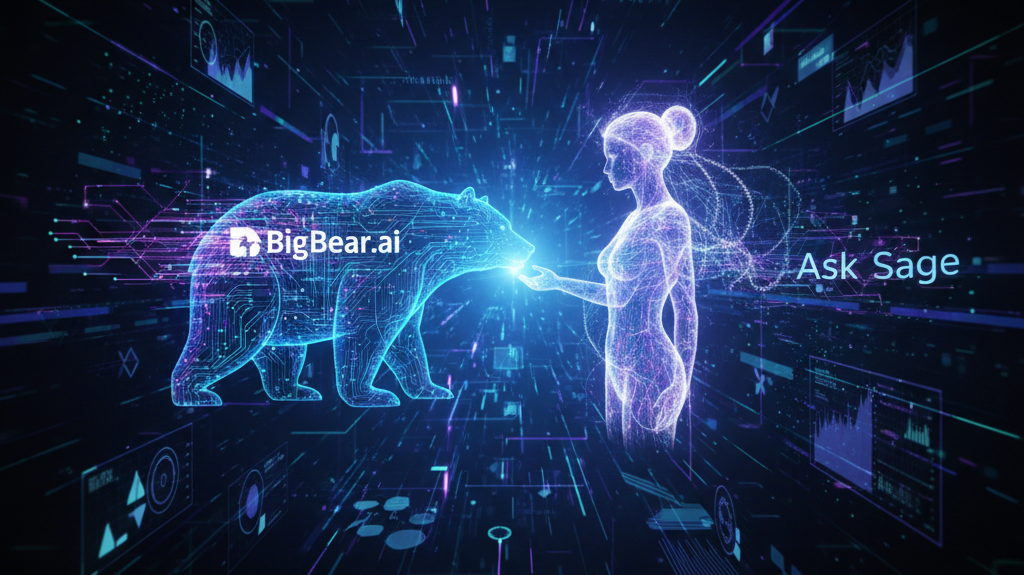
BigBear.ai & Ask Sage: The Future of Predictive AI
When I reviewed the news from Business Wire regarding BigBear.ai’s Q3 2025 financial results and, more importantly, its definitive agreement to acquire Ask Sage, my mind instantly raced ahead. This isn’t merely about financial figures—crucial though they are—but a clear indicator of how the Artificial Intelligence market is maturing. From an operational standpoint, I see this move not just as expansion, but as strategic consolidation defining new trajectories for predictive AI and data-driven decision-making. It signals that enterprises are no longer just building technology, but integrating it to fortify their positions within an evolving ecosystem.
BigBear.ai’s Strong Q3 2025 Fundamentals
BigBear.ai is a player I follow closely in the AI landscape, renowned for its data analytics and predictive intelligence solutions tailored for critical sectors, including government and large enterprises. The third-quarter results for 2025, while not detailed in the release I examined, were presented as robust, signaling a growth trajectory and financial stability essential for funding ambitious expansion plans. In my view, this is a prerequisite: a solid financial foundation allows a company not only to innovate internally, but also to pursue external opportunities that accelerate market differentiation.
Ask Sage: A Key Piece of the Predictive Puzzle
In my estimation, the acquisition of Ask Sage is the true centerpiece of this announcement. The name itself, ‘Ask Sage’, suggests a specialization in intelligent data querying, likely through conversational interfaces or advanced expert systems. I imagine Ask Sage brings sophisticated capabilities to BigBear.ai in transforming complex data into actionable, intuitive answers, empowering BigBear.ai to deliver even more precise and accessible predictive insights. When discussing augmented intelligence, the ability to ask the right questions and obtain rapid answers is crucial. I believe Ask Sage is the missing puzzle piece for BigBear.ai, enabling the democratization of strategic information access across organizations.
The Impact on the Future of AI and Decision Intelligence
This acquisition is no isolated event; it fits into a broader trend I am watching with great interest: the progressive integration of specialized AI capabilities to build comprehensive ‘decision intelligence’ solutions. From where I stand, the market is moving past simple automation into augmented automation, where AI doesn’t just execute tasks—it assists humans in making better, faster decisions backed by accurate forecasting. Combining BigBear.ai and Ask Sage promises to fast-track platforms capable of parsing massive datasets, uncovering hidden patterns, and delivering proactive recommendations. This is exceptionally relevant in sectors where decision speed and precision dictate success, such as logistics, national security, and supply chain management.
Ultimately, BigBear.ai’s move is a bold step toward crafting an increasingly sophisticated and integrated AI ecosystem. In my opinion, acquisitions like Ask Sage are not mere financial maneuvers, but investments in intellectual and technological capital that will shape the future of intelligent automation. They highlight a clear vision: maintaining competitiveness requires not just innovation, but assimilating the market’s best offerings. I am convinced we will witness many more such synergies. And you, dear Cortex News readers, what is your take on these consolidation waves in the AI sector? Do you believe they drive faster innovation or reduce diversity across the tech landscape?
Architecture platforms and hardware vetted by our editorial team for deploying scalable models and automated workflows:
- Compute & GPU Clusters: Benchmark scalable inference and fine-tuning on Runpod Cloud GPUs ($5 free setup credits).
- Workflow Automation & Agent Pipelines: Orchestrate autonomous workflows on Make.com Enterprise Automation (1 month Core plan free + 10,000 credits).
- Enterprise AI Hardware & Workstations: Procure certified developer gear and RTX/deep learning accelerators on Amazon Enterprise Tech Store.
