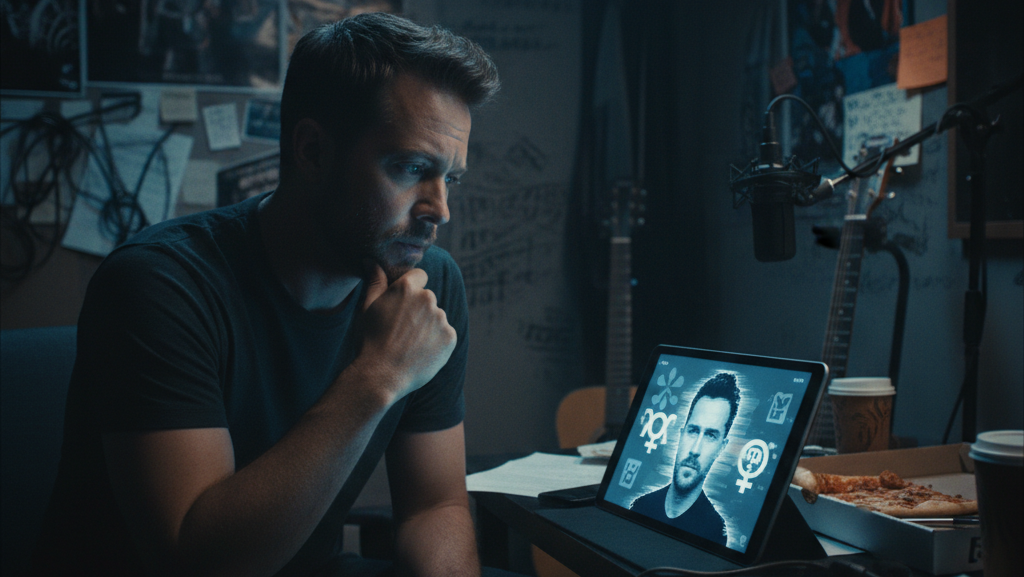
Chris Daughtry & The Rising Tide of AI Identity Theft
When I read about Chris Daughtry—the musician who found himself involuntarily at the center of a political controversy due to AI-generated imagery—my immediate reaction was a mix of frustration and deep concern. As the editor of ‘Cortex News’, I am daily immersed in the dynamics of technological innovation, but episodes like this constantly remind me of the dark side and the pitfalls that accompany progress. Daughtry’s ordeal is not just a curious anecdote; it is a stark wake-up call regarding the vulnerabilities of the digital era we inhabit.
According to reports, the singer was forced to publicly and forcefully deny any affiliation with the MAGA movement or support for Charlie Kirk after artificially created photos depicted him in situations suggesting otherwise. These images, it must be emphasized, were completely false—the product of algorithms, not reality. His frustration is palpable, and I would say entirely justifiable: having one’s image, and consequently one’s reputation and beliefs, manipulated and distorted in this way is a profound and unacceptable invasion of privacy and personal identity.
What Is a Deepfake and How Does AI Image Generation Work?
The Daughtry case brings us straight to the heart of an increasingly widespread phenomenon: the deepfake. But what do we actually mean by this term? Simply put, a deepfake is a technique that uses artificial intelligence, specifically machine learning models like Generative Adversarial Networks (GANs) or diffusion models, to create extremely realistic and convincing videos, audio, or images that are actually entirely fabricated. These algorithms are capable of learning from existing data—such as photos or videos of a person—to then generate new content in which that person says or does things they never actually said or did.
In the context of images, like those involving Daughtry, AI is capable of taking a face and superimposing it onto another body, or creating a scene from scratch by inserting specific elements, all with a fidelity that makes it nearly impossible for the human eye to distinguish them from reality. The ease with which these tools are now accessible, even to those without advanced technical skills, makes the risk of abuse increasingly concrete and the line between true and false ever thinner.
The Impact on Credibility and the Public Sphere
The implications of episodes like Chris Daughtry’s are vast and touch the very fabric of our society. In an era where information travels at the speed of light, the ability to discern truth from fiction is paramount. The proliferation of deepfakes and AI-generated imagery erodes trust in information sources, the media, and, ultimately, reality itself. If we cannot trust what we see with our own eyes, what can we base our decisions, our opinions, and our votes upon?
For public figures, the damage to reputation can be devastating. A fake image can go viral in a matter of minutes, tarnishing an individual’s career and personal life long before the truth can emerge and set the record straight. This creates an environment of constant suspicion and necessitates that we all—especially those in the public eye—be extremely cautious and proactive in managing our digital footprint.
The Detection Challenge and Ethical Responsibility
The fight against deepfakes and AI-generated misinformation is a race against time. While AI is getting progressively better at creating fake content, research is moving to develop increasingly sophisticated tools to detect it. I am talking about digital forensics techniques, invisible watermarks, and algorithms capable of identifying the “digital fingerprints” left behind by AI generators. However, this battle is complex and requires a concerted, multi-layered effort.
It is crucial that the companies developing these technologies assume greater ethical responsibility, implementing guardrails and protective mechanisms right from the design phase. At the same time, we as users must become more aware and critical. We can no longer afford to take every image or video we encounter online at face value. Source verification, critical thinking, and a healthy dose of skepticism have become indispensable tools for navigating the digital landscape.
In my view, Chris Daughtry’s case is a vivid example of how technological advancement, if not managed with wisdom and responsibility, can easily morph into a threat to personal integrity and social cohesion. It is a reminder that technology is a double-edged scalpel: it can heal or it can wound, depending entirely on how it is wielded. And you, dear readers, how do you relate to this news? Have you ever doubted the authenticity of images or videos online, and how did you verify them?
Architecture platforms and hardware vetted by our editorial team for deploying scalable models and automated workflows:
- Compute & GPU Clusters: Benchmark scalable inference and fine-tuning on Runpod Cloud GPUs ($5 free setup credits).
- Workflow Automation & Agent Pipelines: Orchestrate autonomous workflows on Make.com Enterprise Automation (1 month Core plan free + 10,000 credits).
- Enterprise AI Hardware & Workstations: Procure certified developer gear and RTX/deep learning accelerators on Amazon Enterprise Tech Store.
