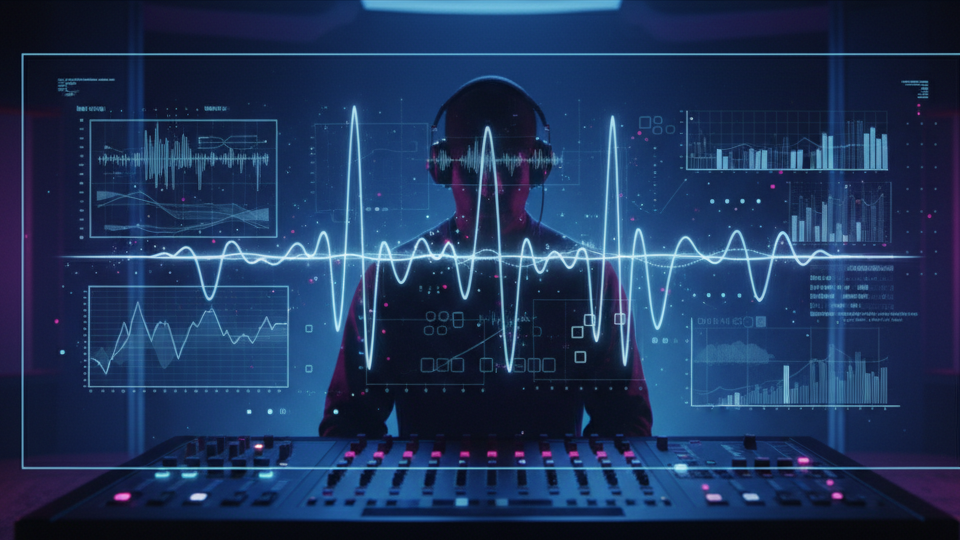
AI Tops Billboard: The Dawn of a Transparent Future
When I read the news that a song created entirely by artificial intelligence had reached the top of the Billboard charts, I felt a chill. It was a mix of awe at the incredible technological progress and a subtle unease. As the Editor-in-Chief of Cortex News, my job has always been to explore the intersection of technology and society, and this event represents a turning point we simply cannot ignore. I immediately asked myself: what does this mean for music, for artists, and above all, for us consumers?
The rise of an AI-generated track onto the world’s most coveted charts is not just a passing curiosity; it is a loud and clear signal. It demonstrates not only the growing sophistication of artificial intelligence algorithms, but also their ability to produce content that resonates with the general public, to the point of surpassing human creations in popularity. But what lies behind this “creation” and what profound implications does it conceal?
Understanding Music Creation via AI
Often, when we talk about “AI music,” the image that comes to mind is a machine generating tracks from scratch at the push of a simple button. The reality, of course, is far more complex and fascinating. These systems are trained on vast datasets of existing music, learning patterns, harmonic structures, melodies, and rhythms. AI doesn’t “feel” music like we do, but it learns to predict the most pleasing or effective sound sequences based on what it has analyzed. Advanced algorithms can then combine these learnings to compose new tracks, sometimes with the intervention of a human producer who directs the style, selects the best parts, or even sings them, as in more complex projects. It is an often invisible collaboration between human and machine.
The Transparency Dilemma
This is where the crucial bottleneck of transparency comes into play. In my view, the lack of a clear indication regarding the origin of a musical work—whether it was composed, produced, or even primarily executed by an AI—raises a host of ethical and practical questions. For the listener, knowing a track’s genesis can completely change their perception and the value assigned to it. Think of authenticity, the emotion we attribute to human art. If we don’t know what we are listening to, how can we form an informed judgment? Furthermore, there is the thorny issue of copyright and compensation. Who holds the rights to an AI-generated song? And how are the human artists whose work was used to train these models remunerated?
The Impact on Industry and Creativity
The music industry has always been at the forefront of adopting new technologies, from synthesizers to digital production software. AI is the next step, a powerful tool that can democratize music production, enabling more people to create. However, this democratization also brings the potential for market saturation and a redrawing of what it means to be an “artist.” If an algorithm can generate hits, doesn’t the value of human creativity, lived experience, and personal expression risk being diminished? I firmly believe that AI should not replace humans, but rather amplify their capabilities. To do this, however, we need clear rules and, above all, a commitment to transparency that goes beyond mere labeling.
Assessing the production trade-offs, the era of AI-generated music has just begun and promises to be as exciting as it is complex. We must not fear progress, but we must manage it with wisdom and responsibility. Transparency is not just a matter of informational fairness, but a fundamental pillar for maintaining the integrity of the creative process and allowing the public to engage with art authentically and consciously. Without clarity, we risk losing the intrinsic value of artistic expression. What do you think, Cortex News readers? Are you ready to accept AI-created music, provided it is clearly labeled, or do you prefer the creative process to remain an exclusively human domain?
Architecture platforms and hardware vetted by our editorial team for deploying scalable models and automated workflows:
- Compute & GPU Clusters: Benchmark scalable inference and fine-tuning on Runpod Cloud GPUs ($5 free setup credits).
- Workflow Automation & Agent Pipelines: Orchestrate autonomous workflows on Make.com Enterprise Automation (1 month Core plan free + 10,000 credits).
- Enterprise AI Hardware & Workstations: Procure certified developer gear and RTX/deep learning accelerators on Amazon Enterprise Tech Store.
