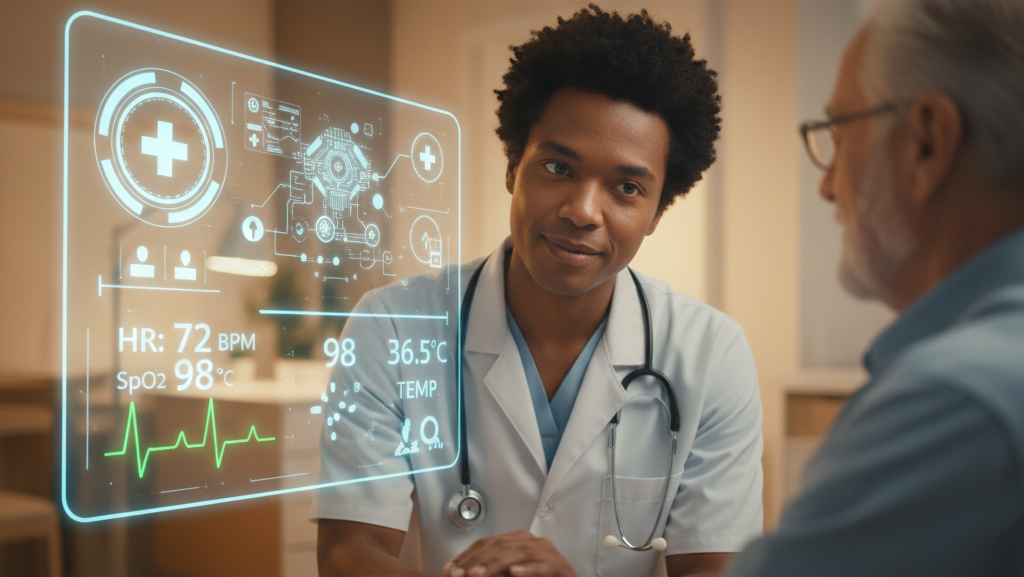
AI on the Hospital Ward: Transforming Nursing Care
When I first came across the news regarding a series of lectures on artificial intelligence in nursing, my initial reaction was a mix of enthusiasm and deep reflection. Here at Cortex News, we constantly explore the intersections between technology and humanity, and this topic is its perfect embodiment. Personally, I have always believed that technology should empower, not replace, human capabilities. In the healthcare sector, this principle is crucial. The initiative by UT Health San Antonio provides a significant window into how AI is beginning to redefine one of the noblest and most demanding professions.
AI in Nursing: Definition and Applications
Often, when we talk about artificial intelligence, we imagine humanoid robots or cold algorithms. But in a clinical context, AI manifests in subtler and incredibly powerful ways. I am talking about systems that analyze vast patient datasets to identify patterns, predict complication risks, or optimize care plans. These are clinical decision support tools, virtual assistants for medical record management and scheduling, or even assistive robots for repetitive and physically demanding tasks. All of this frees up nursing staff, allowing them to dedicate themselves to what truly matters: human contact and direct care. This is AI that amplifies work, not steals it, transforming daily challenges into opportunities for greater efficiency and more targeted care.
Benefits, Ethical Challenges, and the Need for New Skills
The potential benefits are enormous. Imagine a nurse’s ability to access faster, more accurate diagnoses thanks to predictive analytics, or to reduce their administrative burden by letting an AI system handle documentation. This not only improves efficiency and precision, but can also combat staff burnout, an endemic problem in the industry. However, the question I always ask myself is: where does automation end and the indispensable need for the “human touch” begin? Empathy, listening, and non-verbal understanding are intrinsically human skills. The challenge, according to my analysis, is to design AI to reinforce these qualities, not erode them. UT Health San Antonio’s initiative to dedicate a lecture series to this topic is a clear and strong signal: the future of nursing will require a new set of skills. Training must include not only technical aspects, but also a deep ethical and critical reflection on the impact of AI. My fear is that, without proper preparation, technology may be perceived as a threat rather than an ally. It is our responsibility, as technology professionals, to facilitate this transition by addressing the ‘how,’ ‘why,’ and ‘when’ of AI application.
In conclusion, exploring AI in nursing is a crucial step forward toward a healthcare system that is more efficient, secure, and—paradoxically—more human. In my view, we are not talking about replacing the nursing profession, but about an evolution that expands its scope and improves the quality of work, allowing healthcare workers to focus on their most precious added value: patient care and interaction. The question I pose to you, dear Cortex News readers, is: how ready are you to see technology enter so deeply into the sphere of personal care? And what, in your opinion, are the ethical boundaries we must never cross to keep humanity at the center of healthcare?
Architecture platforms and hardware vetted by our editorial team for deploying scalable models and automated workflows:
- Compute & GPU Clusters: Benchmark scalable inference and fine-tuning on Runpod Cloud GPUs ($5 free setup credits).
- Workflow Automation & Agent Pipelines: Orchestrate autonomous workflows on Make.com Enterprise Automation (1 month Core plan free + 10,000 credits).
- Enterprise AI Hardware & Workstations: Procure certified developer gear and RTX/deep learning accelerators on Amazon Enterprise Tech Store.
