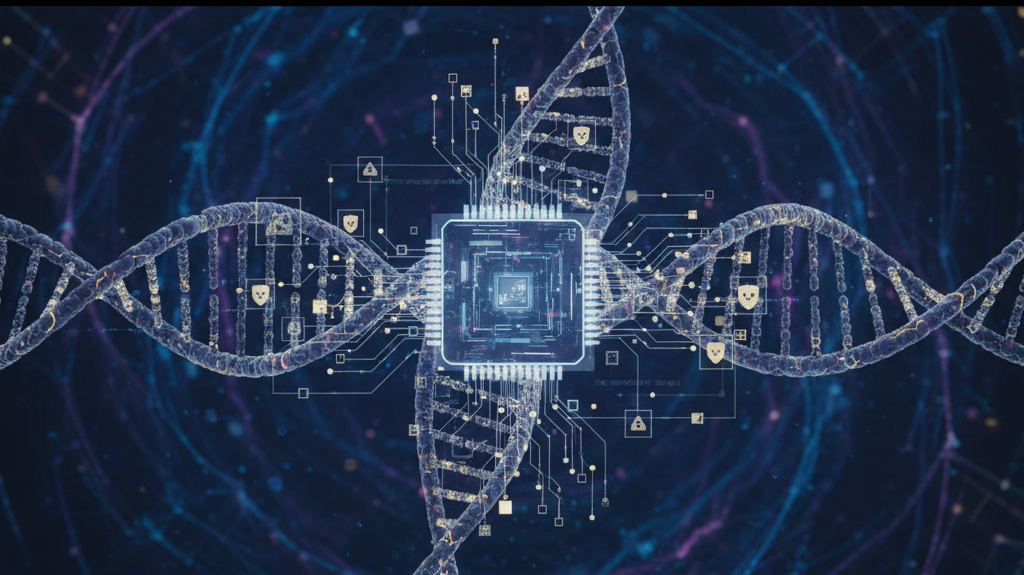
Genomics on Blockchain: The Scilex-Datavault AI Agreement Redefines the Value of Our DNA
When I read the news about the agreement between Datavault AI and Scilex Holding Company, the first thing that jumped to my mind wasn’t just the impressive figure—$10 million for an exclusive license—but above all, the profound implication of what we are discussing: the tokenization of Real-World Assets (RWAs) applied to genomic data and DNA. This, dear ‘Cortex News’ readers, is not a simple business deal; it is a potential watershed moment in how we perceive, manage, and monetize the most intimate and precious information we possess: our genetic code.
What is RWA Tokenization in the Genomic Context?
For those unfamiliar with the term, RWA tokenization refers to the process of representing physical or digital real-world assets as digital tokens on a blockchain. Usually, we talk about real estate, art, or commodities. But applying it to sensitive data like genomic information is a quantum leap. Imagine your DNA data, diagnostic, therapeutic, or genetic information transformed into digital tokens, unique and verifiable on a blockchain. This not only guarantees an unprecedented level of security and immutability, but also opens the door to entirely new monetization models. Scilex, with this license from Datavault AI, positions itself to explore this very territory, aiming to create value from an asset that has thus far been treated predominantly as static, protected information.
Datavault AI and Scilex: An Alliance for the Future of Digital Health
The $10 million agreement grants Scilex exclusive global rights to use Datavault AI’s technology for the tokenization and monetization of this vast spectrum of biological data. This means that Scilex will be able to develop applications and platforms that make it possible to leverage this data in ethical and secure ways. Think of the implications for pharmaceutical research, where access to anonymized and tokenized genomic datasets could accelerate the discovery of new drugs and personalized therapies. Or the possibility for individuals to have greater control and, potentially, a direct economic benefit from sharing their genetic data, always in compliance with privacy and consent.
The Challenges and Opportunities of Unexplored Territory
Naturally, an innovation of this magnitude is not without its challenges. Ethical issues, privacy protection, and the need for clear regulations will be central. But the potential is enormous. This agreement suggests a future where personalized health is no longer just a concept, but a reality empowered by blockchain, where genomic data becomes a dynamic resource capable of generating value not only for corporations, but hopefully also for the original holders of that data. It is a bold step toward a more transparent and efficient health data economy.
In my opinion, this move by Scilex and Datavault AI is a strong signal that the intersection of biotechnology and blockchain is maturing rapidly, promising to unlock value in ways that, until a few years ago, were pure science fiction. It is a reminder that the future of medicine is also a digital and decentralized future. But dear readers, are you ready to see your DNA transformed into a digital asset? What are your main concerns or hopes regarding this evolution?
Architecture platforms and hardware vetted by our editorial team for deploying scalable models and automated workflows:
- Compute & GPU Clusters: Benchmark scalable inference and fine-tuning on Runpod Cloud GPUs ($5 free setup credits).
- Workflow Automation & Agent Pipelines: Orchestrate autonomous workflows on Make.com Enterprise Automation (1 month Core plan free + 10,000 credits).
- Enterprise AI Hardware & Workstations: Procure certified developer gear and RTX/deep learning accelerators on Amazon Enterprise Tech Store.
