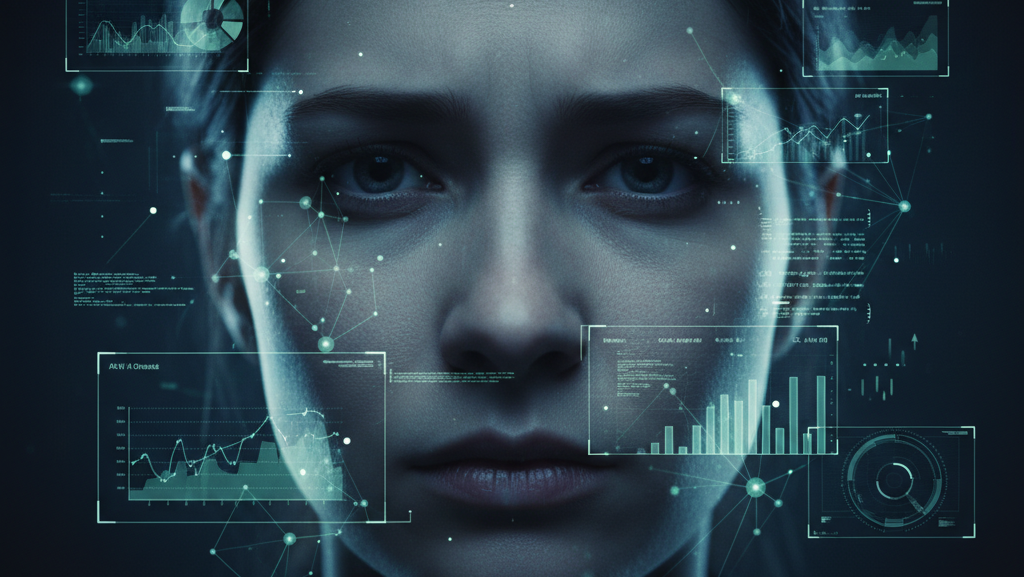
AI’s Digital Eye Spots Human Deception
When I read the news about the Michigan State University (MSU) study regarding AI’s ability to detect human deception, my mind was immediately hooked by a fundamental question: how close is technology to penetrating one of the most complex and intrinsically human aspects of communication? For us humans, recognizing deception is a subtle art, made of micro-expressions, a slightly altered tone of voice, or a fleeting glance. It is a field where intuition and experience play an enormous role. But AI? What struck me is how research is now exploring the capacity of machines to decipher these signals, potentially surpassing our own limitations.
The Deception Challenge for Artificial Intelligence
Deception is a multi-layered phenomenon. It is not just about telling falsehoods, but also about how one does it. Consider non-verbal cues: gaze aversion, nervous tics, a forced smile, or even shifts in posture. These are all clues that our social intelligence processes, often unconsciously. For AI, these signals have traditionally been hostile territory. Machines excel at structured data analysis, but the fluidity and ambiguity of human behavior present a massive challenge. Yet, therein lies the fascination of the MSU study: training algorithms to recognize patterns that escape us or that we interpret through the lens of cognitive bias.
The MSU Study’s Innovative Method
The MSU study focused on utilizing advanced machine learning techniques to analyze a vast array of non-verbal signals. Imagine algorithms that not only recognize a face, but are capable of mapping and interpreting the minutest muscle contractions, involuntary eye movements, or variations in vocal tone. This is not about delivering an infallible ‘verdict’, but rather about identifying correlations between specific behaviors and the act of deception, based on previously labeled datasets. This data-driven approach allows AI to ‘learn’ the patterns associated with lying, often with a precision that exceeds that of human observers, who are subject to fatigue, distraction, and cognitive biases.
Ethical and Real-World Implications: A Double-Edged Sword
The potential applications of such technology are vast and, in my view, deserve deep reflection. One might think of national security, high-risk job interviews, or even the legal sphere, where identifying signs of deception could support judges or investigators. However, it is imperative to consider the flip side: the ethical implications. Individual privacy, the risk of ‘false positives’ that could ruin reputations or careers, and the potential for abusing such powerful technology are real concerns. As the editor of ‘Cortex News’, I firmly believe that every step forward in AI must be accompanied by a robust ethical debate and rigorous safeguards.
The Future of Human-AI Interaction and Its Limits
This study is another piece in the evolving relationship between humans and machines. We are not talking about an AI that ‘understands’ human intent in an emotional sense, but one that recognizes behavioral patterns with greater precision. The road to a flawless AI ‘lie detector’ is still long and fraught with obstacles. Culture, context, and human individuality make every instance of deception unique. Nevertheless, the MSU research shows us that machines can become valuable tools to help us navigate the complexity of human communication. In my opinion, the crucial point is not whether AI will ever replace human judgment, but how it can integrate to make us more aware and informed. What do you think about an AI that ‘sees’ what escapes us?
Architecture platforms and hardware vetted by our editorial team for deploying scalable models and automated workflows:
- Compute & GPU Clusters: Benchmark scalable inference and fine-tuning on Runpod Cloud GPUs ($5 free setup credits).
- Workflow Automation & Agent Pipelines: Orchestrate autonomous workflows on Make.com Enterprise Automation (1 month Core plan free + 10,000 credits).
- Enterprise AI Hardware & Workstations: Procure certified developer gear and RTX/deep learning accelerators on Amazon Enterprise Tech Store.
