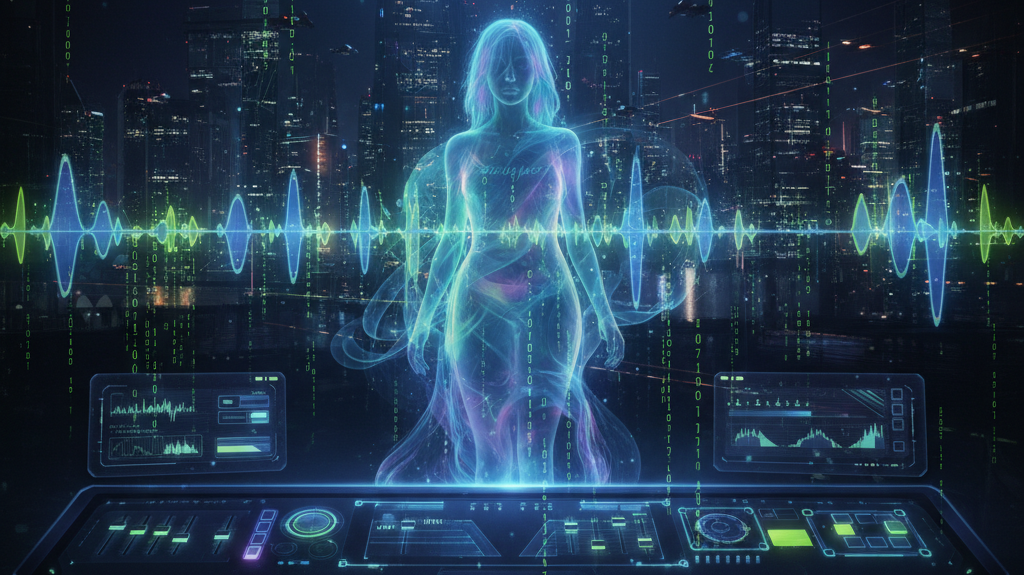
Xania Monet & the AI Artist Dawn: A New Era on Billboard
When I read the news that Xania Monet, an entirely AI-driven artist, had debuted on the Billboard airplay charts, my initial reaction was a mix of awe and deep reflection. At ‘Cortex News’, we have always closely tracked the evolution of AI, but seeing its creation not only enter but compete in the sacred temple of popular music marks a point of no return. This is no mere experiment; it is a bold statement about the future of art and technology.
Who is Xania Monet and How Does It Work?
Xania Monet is neither flesh and blood nor a traditional human-controlled avatar. It is a musical entity generated and managed by artificial intelligence algorithms. Imagine a system that analyzes vast datasets of songs, lyrics, melodies, and vocal styles, learning not just to replicate them, but to craft original compositions that resonate with current trends. Her debut on Billboard, the chart monitoring radio airplay, means AI-generated music is starting to be perceived by the mainstream public as a valid and, above all, listenable product.
The Impact on the Music Landscape
This event raises fundamental questions. On one hand, it opens the door to unprecedented creativity, enabling experimentation with genres and sounds that might be difficult to achieve through traditional methods. AI can compose incessantly, explore endless variations, and even adapt in real time to listener feedback. On the other hand, crucial questions arise regarding artistic authorship, copyrights, and the role of human artists. If an AI can create radio hits, what will be the added value of human expression? My sense is that AI will not replace human creativity, but rather push it to evolve, forcing us to redefine what we mean by ‘art’ and ‘artist’.
Underlying Technology and Future Prospects
Behind Xania Monet lie advanced generative AI models, likely neural networks trained on massive corpora of musical data. These systems do not simply ‘copy and paste’; they are capable of learning complex patterns, harmonic structures, and lyrics, generating original outputs that often challenge our ability to distinguish them from human works. This is just the beginning. I foresee a future where AI is an omnipresent tool in music production, not just for composition but also for arrangement, mastering, and even personalized promotion. The barrier between the human creator and the AI assistant will become increasingly blurred.
In my view, the rise of Xania Monet is not a harbinger of doom for the music industry, but rather a wake-up call for innovation. It is a reminder that technology advances relentlessly and that we must adapt, not just technically, but philosophically as well. The challenge will be integrating these new capabilities ethically and productively, preserving the intrinsic value of human expression while exploring new creative frontiers. What is your opinion: is AI a threat or an opportunity for the future of music?
Architecture platforms and hardware vetted by our editorial team for deploying scalable models and automated workflows:
- Compute & GPU Clusters: Benchmark scalable inference and fine-tuning on Runpod Cloud GPUs ($5 free setup credits).
- Workflow Automation & Agent Pipelines: Orchestrate autonomous workflows on Make.com Enterprise Automation (1 month Core plan free + 10,000 credits).
- Enterprise AI Hardware & Workstations: Procure certified developer gear and RTX/deep learning accelerators on Amazon Enterprise Tech Store.
