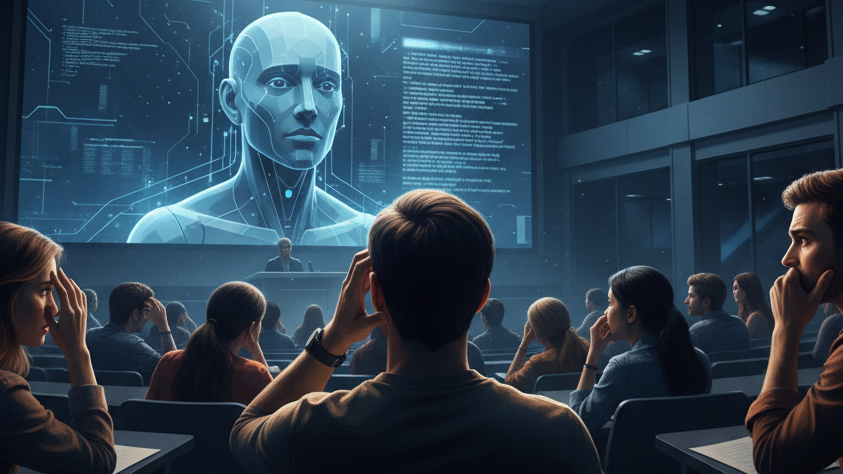
AI Replaces Professor: Campus Revolt Highlights EdTech Limits
When I read the news currently sweeping across the web, my initial reaction was a mixture of surprise and, I must admit, genuine concern. The idea that a university course could be entirely taught by an artificial intelligence without students being fully aware—or worse, willingly accepting it—struck a raw nerve. As the Chief Editor of Cortex News, my job is to analyze technology’s impact on our daily lives, and this specific case is not merely a curiosity; it is a major wake-up call for the future of education.
The Specific Case: A Bitter Lesson
Imagine enrolling in a university course, often paying hefty tuition fees, expecting to interact with an industry expert, a mentor, someone you can actually exchange ideas with. Then, you discover that behind the lectures and the answers to your questions isn’t a flesh-and-blood person, but an algorithm. That is precisely what happened, sparking a full-scale student revolt. The frustration doesn’t stem from the use of technology itself—after all, AI is already an integral part of many educational workflows—but from the complete and opaque replacement of the human professor. This isn’t augmentation; it’s suppression.
Why the Anger? The Value of Human Interaction
In my view, the students’ reaction is entirely understandable. A professor is not merely a distributor of information. They are discussion facilitators, sources of inspiration, critical thinking role models, and frequently, human touchstones. Interacting with an instructor allows students to explore nuances, ask unexpected questions, and receive personalized feedback that goes far beyond formal correctness. No matter how advanced, an AI struggles to replicate empathy, intuition, and the ability to adapt teaching in real time to a class’s emotional and cognitive needs. True learning often flourishes in dialogue, not just through the one-way transmission of data.
AI in Education: Potential vs. Current Reality
Make no mistake: I am a fervent advocate for AI’s potential in education. AI-driven tools can personalize study paths, offer supplemental tutoring, automate repetitive tasks, and make learning more accessible. I think of platforms that adapt to each student’s pace, or systems capable of translating and explaining complex concepts in multiple languages. However, there is a stark difference between using AI as an empowerment tool and delegating entire teaching responsibilities to it. The issue isn’t the AI itself, but how it was deployed in this specific context, completely ignoring students’ fundamental expectations and needs.
The Future of Teaching: Transparency and Accountability
This episode forces us to seriously reflect on the future of education and the ethical role of academic institutions. If universities begin replacing instructors with AI systems lacking transparency or consent, we jeopardize not only educational quality but also trust. Clear communication is paramount from day one: if a course relies heavily on AI, students must know, and alternatives or human oversight must be guaranteed. We must define accountability when AI makes mistakes or fails to meet educational needs. Technology must serve humanity, not the other way around.
Breaking down the architectural realities, and human elements here, I believe this incident is not just a minor slip-up, but a warning siren for the entire education sector and the ethical development of AI. Artificial intelligence can and must be a powerful tool to enrich the educational experience, but it can never fully replace the human touch, empathy, and mentorship that a professor provides. Striking the right balance between technological innovation and human value will be the key to a successful educational future. What are your thoughts? Are you ready to be taught by an AI, or remains the human element utterly irreplaceable in your educational journey?
Architecture platforms and hardware vetted by our editorial team for deploying scalable models and automated workflows:
- Compute & GPU Clusters: Benchmark scalable inference and fine-tuning on Runpod Cloud GPUs ($5 free setup credits).
- Workflow Automation & Agent Pipelines: Orchestrate autonomous workflows on Make.com Enterprise Automation (1 month Core plan free + 10,000 credits).
- Enterprise AI Hardware & Workstations: Procure certified developer gear and RTX/deep learning accelerators on Amazon Enterprise Tech Store.
