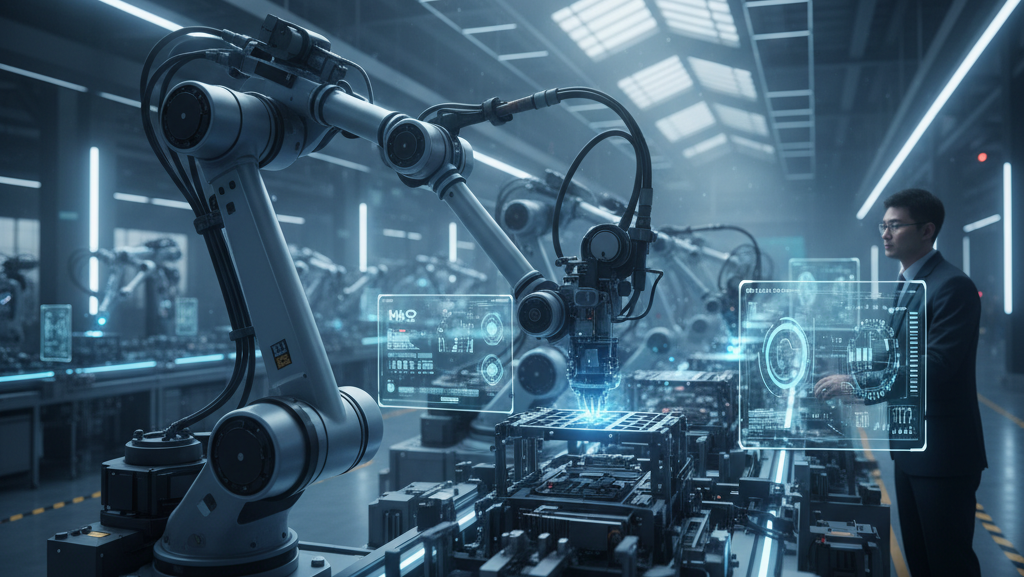
AI Reshapes US Factories: Intrinsic & Foxconn’s Deal
When I first read about the collaboration between Intrinsic, Alphabet’s robotics division, and manufacturing giant Foxconn, I immediately felt a mix of enthusiasm and deep reflection. For anyone who, like me, closely follows technological evolution and its industrial impact, this announcement is far more than a headline; it is a powerful signal—almost a wake-up call—regarding how rapidly global manufacturing is accelerating toward an AI-dominated future. Breaking down the architectural realities, this strategic move could redefine not only the American production landscape, but the very concept of factory ‘work’.
Intrinsic: The Brain Behind Intelligent Automation
Before diving into the partnership’s specifics, it is essential to understand what Intrinsic represents. Born out of Alphabet’s “moonshot” lab X, Intrinsic is not just another robotics company. Their primary focus is developing software and AI systems that empower industrial robots to learn, adapt, and operate with unprecedented flexibility and precision. The goal goes beyond merely automating repetitive tasks; it equips robots with the ability to solve complex problems and adapt to novel scenarios—a monumental leap forward compared to traditionally programmed robots.
Foxconn: The Giant Betting on US-Based AI
On the other side stands Foxconn, a household name in electronics manufacturing. Primarily known as a key supplier for much of our everyday technology, including Nvidia devices, Foxconn maintains a significant US footprint. Their decision to deploy Intrinsic’s AI robots directly inside their American factories is fascinating. Beyond mere efficiency gains, it clearly signals a commitment to reindustrializing and innovating on US soil, potentially mitigating labor cost hurdles and global supply chain complexities.
The Impact: Efficiency, Flexibility, and Manufacturing’s Future
This alliance unlocks productivity levels previously considered unimaginable. Intrinsic’s AI-powered robots will execute delicate, complex tasks with heightened precision, speed, and consistency. Imagine assembly lines adapting in real-time to product variations, or robots autonomously diagnosing and resolving minor operational issues. In my view, this minimizes downtime and waste while enabling the mass production of sophisticated, customized goods. It promises an agile manufacturing ecosystem capable of instantly responding to shifting market demands.
Perspectives and Challenges: A Labor Revolution?
Naturally, such a transformation raises critical questions. While advanced automation promises to boost factory competitiveness and reshore production to the West, we cannot ignore the workforce implications. Undeniably, certain manual and repetitive jobs will be displaced. However, looking at the architectural shift, this transition will simultaneously catalyze new opportunities requiring distinct skill sets: robot operators, AI engineers, and predictive maintenance specialists. The key lies in our ability to train and upskill the existing workforce to tackle these emerging challenges.
In my opinion, this collaboration between Intrinsic and Foxconn transcends a standard commercial agreement; it serves as a manifesto for the future of manufacturing. It marks a pivotal turning point where AI transitions from a laboratory concept into the pulsating core of production lines. This evolution is vital for maintaining a competitive edge in an increasingly ruthless global economy. I am convinced that, managed with foresight and human-centric empathy, this robotic revolution will yield remarkable dividends in both innovation and manufacturing sustainability. But I have to ask: what is your take? Are you optimistic about the opportunities or concerned about the challenges ahead as AI robots take over our factories?
Architecture platforms and hardware vetted by our editorial team for deploying scalable models and automated workflows:
- Compute & GPU Clusters: Benchmark scalable inference and fine-tuning on Runpod Cloud GPUs ($5 free setup credits).
- Workflow Automation & Agent Pipelines: Orchestrate autonomous workflows on Make.com Enterprise Automation (1 month Core plan free + 10,000 credits).
- Enterprise AI Hardware & Workstations: Procure certified developer gear and RTX/deep learning accelerators on Amazon Enterprise Tech Store.
