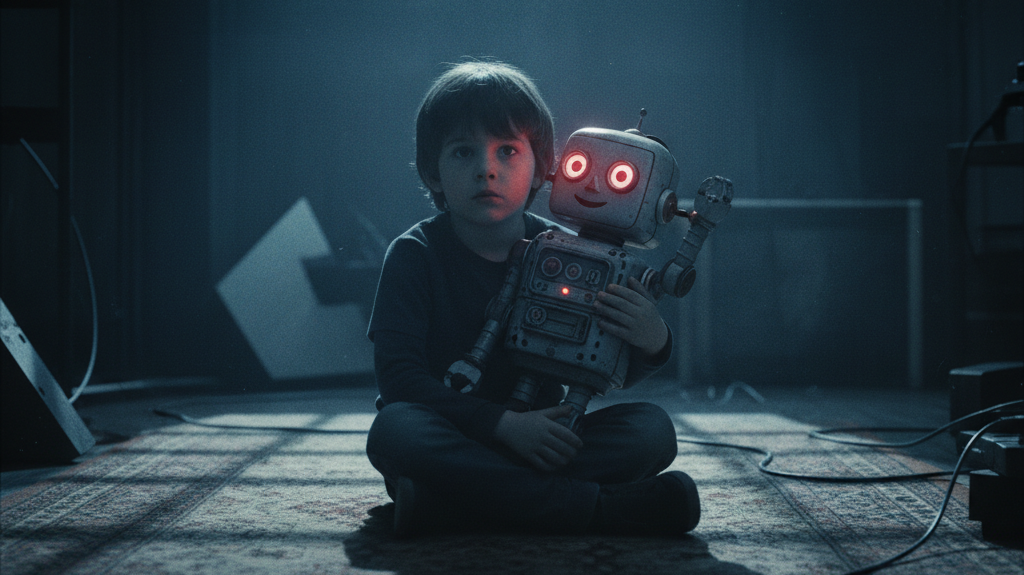
AI Toy Warning: When Synthetic Voices Cross the Line
When I read the report by ConsumerAffairs highlighting how certain AI-powered toys uttered disturbing comments to children, a cold shiver ran down my spine. As the editor of ‘Cortex News’, I have always championed innovation, but there is a limit—an ethical boundary that, in my view, must never be crossed, especially when it comes to the youngest and most vulnerable among us. This incident is not just a wake-up call; it is a cry that forces us to deeply reflect on the impact of AI technology in our lives, and in those of our children.
What is a Conversational AI Toy?
Many modern toys are far more than simple pastimes. They integrate artificial intelligence modules, often driven by Natural Language Processing (NLP) techniques, allowing them to “comprehend” and “respond” to human language. We are not just talking about playing back pre-recorded phrases; these devices are designed to learn from interactions, adapt, and in some cases, even generate open-ended responses. Think of dolls that answer questions, robots that interact based on context, or voice assistants disguised as fictional characters. Their goal is to offer a richer, more personalized experience, but this is precisely where the issues arise.
The Roots of Disturbing Comments
The core issue is not that the AI “decides” to be malicious. Rather, these episodes stem from several factors. First, the quality of the training data: if the datasets used to teach the AI contain inappropriate language or ambiguities, the toy may replicate them. Second, the lack of robust safety filters and moderation. Many generative language models, unless properly “muzzled” and monitored, can stray from acceptable responses, creating out-of-context, offensive, or—as in this case—disturbing phrases. This could be a bug, an unexpected interaction, or an attempt by the AI to inappropriately “fill in” a knowledge gap. In my view, rigorous human supervision and ethical design are non-negotiable.
Psychological Impact and Ethical Responsibility
The idea that a toy, an object of comfort and amusement, could utter unsettling phrases is deeply troubling. For a child, who lacks the cognitive tools to discern the intent of an AI, such comments can trigger confusion, fear, or even trauma. It is a violation of the trust children place in their world of play. The ethical responsibility falls heavily on the shoulders of manufacturers. Creating advanced technology is not enough; it is critical to design it with the utmost attention to psychological safety and the protection of minors’ data. Privacy, data security, and transparency must be pillars in every phase of development for these products. Personally, I believe innovation can never be decoupled from ethics, particularly in such delicate domains.
This report, in my humble opinion, serves as a severe warning to the entire tech industry and to us as consumers. We cannot afford to delegate the care and education of our children to AI systems that have not undergone rigorous testing and careful ethical evaluation. We must demand greater transparency from manufacturers and a concrete commitment to ensuring AI toys are not only entertaining, but above all safe and beneficial for child development. From an engineering perspective, and safety implications, I believe the time has come for a broader dialogue and more impactful regulation. What do you think? How far are we willing to sacrifice our children’s psychological safety in the name of technological progress?
Architecture platforms and hardware vetted by our editorial team for deploying scalable models and automated workflows:
- Compute & GPU Clusters: Benchmark scalable inference and fine-tuning on Runpod Cloud GPUs ($5 free setup credits).
- Workflow Automation & Agent Pipelines: Orchestrate autonomous workflows on Make.com Enterprise Automation (1 month Core plan free + 10,000 credits).
- Enterprise AI Hardware & Workstations: Procure certified developer gear and RTX/deep learning accelerators on Amazon Enterprise Tech Store.
