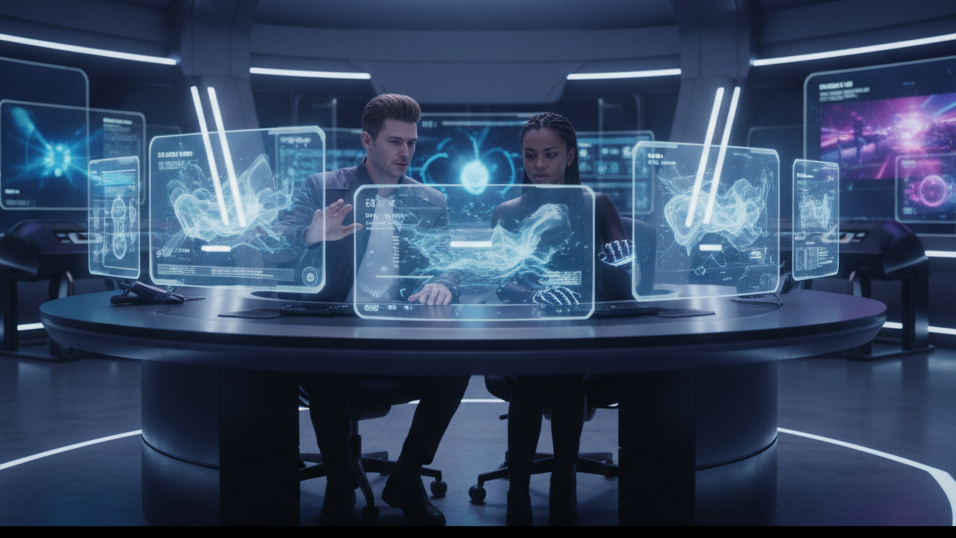
Generative AI in Production: Evolution or Creative Threat?
When I read the news about how production companies are “grappling” with generative AI, my immediate thought was a simple question: is it a threat or an opportunity? Or, as is so often the case in tech, both in equal measure? As the Editor-in-Chief of Cortex News, I constantly find myself analyzing the undercurrents reshaping the digital landscape, and generative AI is undeniably one of the most powerful and complex.
Understanding Generative AI in the Production Context
For those not yet entirely familiar with it, generative AI is the branch of artificial intelligence capable of creating original content—text, images, video, audio—based on training data. Imagine tools that can generate commercials, design prototypes, or even entire narrative scenarios with just a few prompts. This is the future, or rather, the present, that production companies are already exploring. Its ability to automate repetitive processes and accelerate the creative phase is plainly massive, yet it brings new complexities in its wake.
The Major Challenges: Control, Ethics, and the Human Factor
It is not a path without obstacles. From my perspective, the primary concerns lie in maintaining control over the quality and originality of the output. How much can we trust an AI to maintain brand consistency or capture the emotional nuances of a narrative? And then there is the ethical question: copyright on generated content, the use of data for training, and, naturally, the impact on employment. Many industry professionals are rightfully wondering whether their roles will be replaced or simply transformed. In my view, this is a debate that requires a pragmatic, non-ideological approach.
The Illuminating Opportunities: Efficiency and New Creative Expressions
Despite the concerns, the opportunities are equally evident and, I would dare say, thrilling. Imagine the ability to generate dozens of variations of an ad to test effectiveness, or to create backgrounds and digital assets in a fraction of today’s time and cost. Generative AI can free creatives from mundane tasks, allowing them to focus on strategic vision and genuinely innovative ideas. When I reviewed some of the early experiments in this field, I realized we are merely scratching the surface of its potential.
Adapting to Change: The Crucial Human Role
How are companies adapting? Many are investing in internal training, exploring AI as a creative copilot rather than a replacement. The goal is not to delegate entirely, but to amplify human capabilities. This means developing new skill sets, understanding the limitations and potential of algorithms, and, above all, keeping creative leadership firmly in human hands. My prediction is that those who successfully integrate AI intelligently, while keeping an eye on authenticity and ethics, are destined to thrive.
In my opinion, generative AI is not a passing trend, but a profound transformation of the production sector. It is not a matter of choosing whether to use it or not, but of how to integrate it ethically and effectively to enrich creativity and efficiency. Production companies that adopt a mindset of continuous learning and experimentation will be the ones defining the future. And you, dear readers, how do you view this marriage between human creativity and artificial intelligence? Are you optimistic or cautious?
Architecture platforms and hardware vetted by our editorial team for deploying scalable models and automated workflows:
- Compute & GPU Clusters: Benchmark scalable inference and fine-tuning on Runpod Cloud GPUs ($5 free setup credits).
- Workflow Automation & Agent Pipelines: Orchestrate autonomous workflows on Make.com Enterprise Automation (1 month Core plan free + 10,000 credits).
- Enterprise AI Hardware & Workstations: Procure certified developer gear and RTX/deep learning accelerators on Amazon Enterprise Tech Store.
