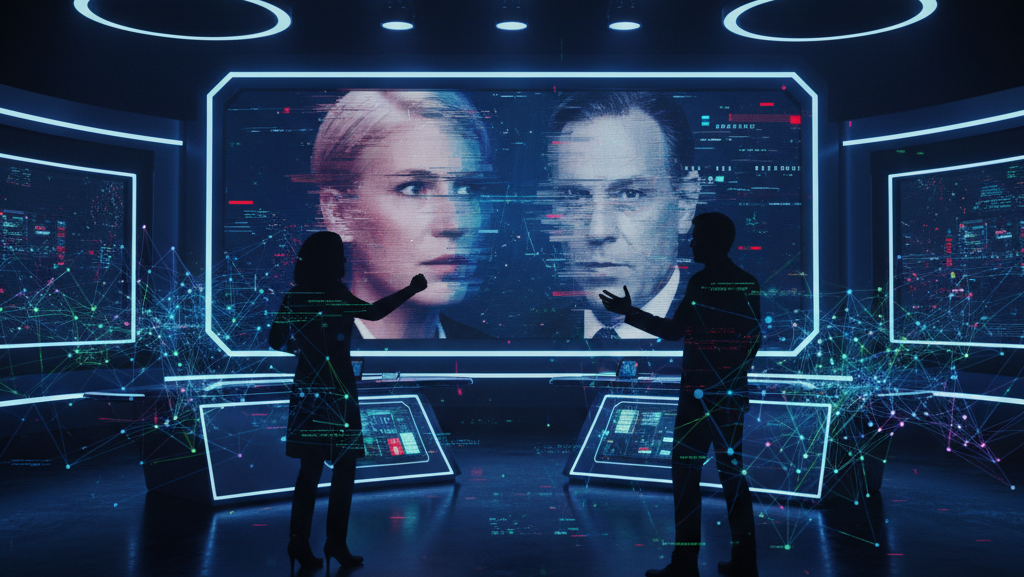
AI at the Heart of Indian Politics: When Digital Truth Challenges Democracy
When I first read the news from Bihar, a local Indian election, my immediate reaction was one of surprise and, honestly, a touch of concern. Seeing a political dispute centered around such a peculiar controversy as the term ‘Nachaniya’ escalate into a debate over a video’s authenticity and the role of artificial intelligence immediately set off my alarm bells. As the Editor-in-Chief of ‘Cortex News’, my focus quickly shifted from local political dynamics to the broader implications such an episode carries for the future of information and democracy.
The affair, which involved BJP leader Manoj Tiwari and Bihar’s Deputy Chief Minister Samrat Choudhary during “NDTV Powerplay”, revolves around a video and the accusation of using a derogatory term. The focal point of the discussion unexpectedly became whether the video in question was digitally altered or even generated with AI, rather than serving as an authentic representation of the facts. It is fascinating—and unsettling—how the suspicion of digital manipulation can now call into question even the most concrete-seeming evidence, even a video.
Deepfakes and the Fine Line Between Truth and Falsehood
The term ‘deepfake’ is by now sadly familiar. It refers to multimedia content (video, audio, images) created or manipulated using artificial intelligence to make it look like someone said or did something they never actually did. Although in the specific case of Bihar it has not been confirmed as a pure AI deepfake, the debate over its authenticity highlights the growing difficulty in distinguishing truth from falsehood. The mere act of doubting the origin of a video in an electoral context—even if it ultimately turns out to be authentic but misinterpreted—is a potent symptom of how severely digital trust has been eroded. It is an immense challenge for anyone working in information, and for citizens themselves.
AI: A Double-Edged Sword at the Heart of Democracy
Artificial intelligence, as often happens with powerful technologies, is a double-edged sword. On one hand, it allows us to create and simulate reality with surprising verisimilitude; on the other, that same AI is our best hope for detecting and combating the disinformation it can generate. The arms race between deepfake creators and detectors is in full swing. Events like the one in Bihar underscore the urgency of developing increasingly sophisticated AI systems for content verification. But we cannot rely on technology alone; critical human capacity and media literacy become more crucial than ever. Personally, I have always maintained that technology is an enabler, but ultimate responsibility rests with the individual and institutions.
This episode, specific though it may be, is emblematic of a global problem. In an era of polarization and immediate access to a endless stream of information, media manipulation—whether AI-generated or the result of more rudimentary editing—can have a devastating impact on the democratic process. The ability to sow doubt about the authenticity of any visual or auditory evidence is a direct threat to public trust in elections, the media, and ultimately, the institutions themselves. For me, the lesson is clear: transparency and rigorous verification must be the pillars of all communication in such delicate contexts.
In my view, what happened in Bihar is a powerful warning. It reminds us that the intersection of politics, technology, and information is an increasingly mined terrain. It is no longer enough to distinguish between ‘true news’ and ‘fake news’; we must now question the very authenticity of the medium conveying the message. The responsibility of us journalists, AI developers, and lawmakers is enormous. We must educate, inform, and provide the tools to navigate this new reality. But I pose the most important question to you, the readers: how do you think we can collectively safeguard truth and trust in the era of AI and elections?
Architecture platforms and hardware vetted by our editorial team for deploying scalable models and automated workflows:
- Compute & GPU Clusters: Benchmark scalable inference and fine-tuning on Runpod Cloud GPUs ($5 free setup credits).
- Workflow Automation & Agent Pipelines: Orchestrate autonomous workflows on Make.com Enterprise Automation (1 month Core plan free + 10,000 credits).
- Enterprise AI Hardware & Workstations: Procure certified developer gear and RTX/deep learning accelerators on Amazon Enterprise Tech Store.
