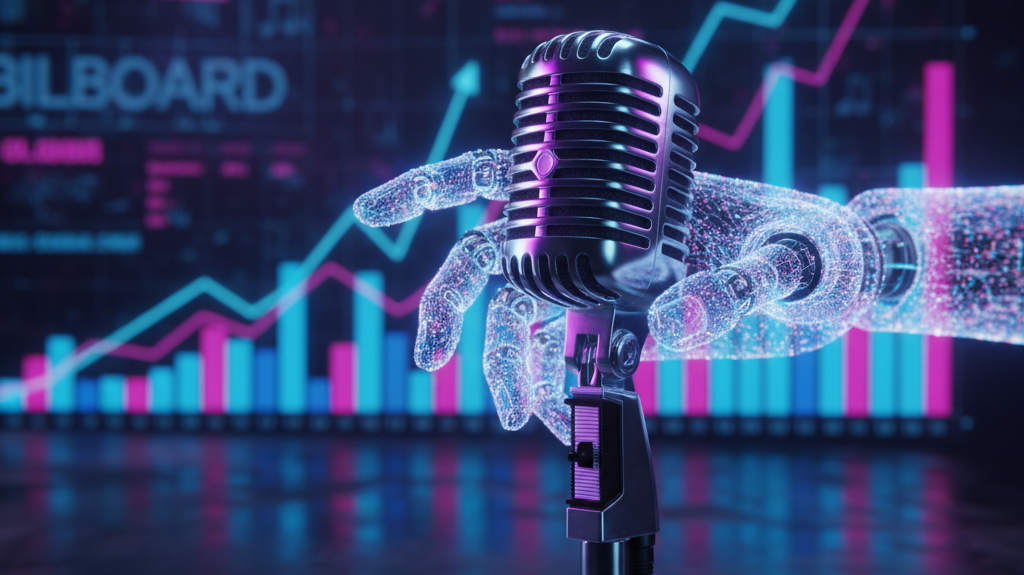
AI Conquers Billboard: US Copyright and the Future of Music
When I read the news that the United States Copyright Office is carefully evaluating the growing presence of AI-assisted artists on the prestigious Billboard charts, I felt a jolt. This is not merely a technological curiosity, but a true watershed moment for the music industry and, more broadly, for the very concept of creativity and authorship. For years, I have observed the evolution of AI, but seeing it break into a sector so steeped in human passion as music—with such profound legal implications—has made me seriously ponder the future we are building.
The Phenomenon of AI-Assisted Artists
What exactly does an ‘AI-assisted artist’ mean? We aren’t talking about a robot singing on stage, at least not yet. Rather, we are looking at sophisticated software and algorithms capable of generating melodies, lyrics, arrangements, and even entire vocal performances, often starting from minimal inputs or the analysis of vast musical libraries. These tools allow producers, and yes, even human artists, to create works that sometimes defy the distinction between what is generated by a human mind and what is the fruit of an algorithm. Their success on streaming platforms and, consequently, their rise on the Billboard charts, is an unequivocal sign of how this technology is already reshaping the musical landscape.
The US Copyright Office’s Stance
The issue facing the Copyright Office is complex and multi-layered. Traditionally, copyright has been granted to works created by human beings, recognizing ‘paternity’ and intellectual originality. But if a track has been entirely or partially generated by an AI, who holds the rights? The engineer who programmed the AI? The user who provided the inputs? Or perhaps the AI itself, if it could be considered a creative entity? I have followed similar debates in other sectors, such as the visual arts, but music carries an even greater cultural resonance and economic scale, making this discussion all the more urgent.
The Legal and Ethical Challenges of Authorship
The core of the problem lies in the concept of authorship. Copyright law requires a work to be ‘original’ and to originate from a ‘human author’. AI is not human. This opens a chasm of questions. How do you define originality when an algorithm can draw from and remix countless pre-existing sources? What level of human intervention is sufficient to claim copyright? And, perhaps the thorniest question of all, how will we protect human artists from potential abuses or the devaluation of their art if AI can replicate and even surpass their creations at negligible costs? In my view, this is not about stopping progress, but about channeling it into an ethical and legal framework that values both innovation and human creativity.
The Future of Music and Intellectual Property
This investigation by the US Copyright Office is more than a mere legal technicality; it is a thermometer of our evolving relationship with technology. How we tackle these challenges will have repercussions far beyond the Billboard charts, influencing every form of AI-mediated creative expression. I believe the solution is not simple and will require ongoing dialogue among legislators, technologists, artists, and the public. We must find a balance that encourages innovation without eroding the intrinsic value of human ingenuity and its capacity to create art with a soul. Breaking down the architectural realities, of this digital shift, I see a unique opportunity to redefine the boundaries of creativity and intellectual property, but doing so with foresight and wisdom is paramount. What are your thoughts? Is AI a threat or an unmissable opportunity for art and copyright?
Architecture platforms and hardware vetted by our editorial team for deploying scalable models and automated workflows:
- Compute & GPU Clusters: Benchmark scalable inference and fine-tuning on Runpod Cloud GPUs ($5 free setup credits).
- Workflow Automation & Agent Pipelines: Orchestrate autonomous workflows on Make.com Enterprise Automation (1 month Core plan free + 10,000 credits).
- Enterprise AI Hardware & Workstations: Procure certified developer gear and RTX/deep learning accelerators on Amazon Enterprise Tech Store.
