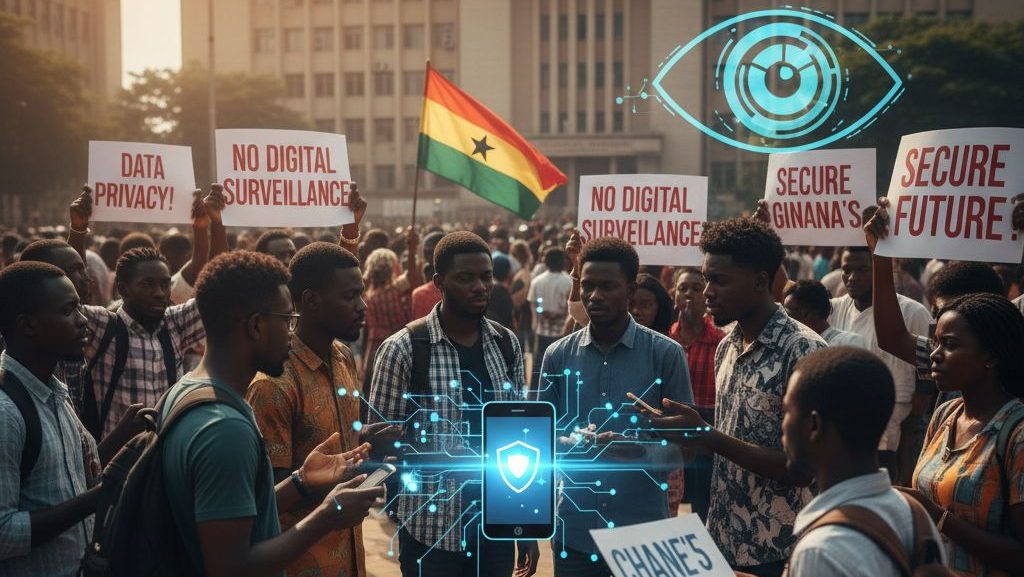
Cybersecurity or Control? Africa’s Digital Freedom Risk
Today marks a development I’ve long anticipated, and unfortunately not in a good way: the debate over cybersecurity as a surveillance weapon. Ghana, at the forefront in Africa, has introduced a bill that, while promising protection, risks limiting civil liberties. Assessing the production trade-offs, this forces us to ask: can national security justify mass surveillance? Let’s dive into this controversy that affects us all.
Ghana, a West African pioneer in rapid digitalization, finds itself at the center of a heated debate regarding its proposed cybersecurity bill. Presented with the stated goal of strengthening the country’s digital defenses against growing threats, the text is raising considerable concerns, turning a legitimate security need into a potential battlefield for rights and civil liberties. The question echoing among tech experts, human rights activists, and ordinary citizens is clear: is this a fundamental step toward greater digital security or a dangerous tool for government control?
There is no doubt that the need for a robust legislative cybersecurity architecture is pressing. With the increasing adoption of digital services, e-commerce, and the digitalization of public services, Ghana has become an attractive target for malicious actors, from cybercriminals to state-sponsored hackers. Data breaches, ransomware attacks, and online fraud can have devastating consequences for the economy, citizen trust, and national stability. An updated regulatory framework providing data protection, clear definitions of cybercrimes, and international cooperation is, in principle, an essential building block for any modern nation’s digital development and prosperity. The Ghanaian government has rightly emphasized the importance of safeguarding critical infrastructure and protecting citizens’ personal data in an increasingly connected environment.
However, it is the breadth and vagueness of certain provisions contained in the bill that generate alarm. Critics, including human rights organizations and journalists’ associations, fear that the clauses could easily be interpreted to justify mass surveillance, limit freedom of expression, and target dissent. The definition of “critical information infrastructure” or “cyber threat” could be stretched to cover social media platforms or news sites, giving authorities sweeping powers to censor content or collect data without adequate judicial oversight. In a context where transparency and accountability are still evolving, such a pervasive bill risks turning into a tool of control rather than protection, undermining citizens’ trust in institutions and the country’s digital future.
The crucial node lies in the balance between national security and fundamental rights. An authentic cybersecurity law should be developed through broad public consultation, including civil society, the private sector, and technical experts, to ensure there are no loopholes that could allow abuses of power. It is vital to establish independent oversight mechanisms, a clear delineation of government agency powers, and the guarantee of legal recourse for citizens whose rights might be violated. Cybersecurity should never be used as a pretext to weaken democratic institutions or silence critical voices, but rather to strengthen a secure, open, and inclusive digital ecosystem where innovation and freedom can thrive.
In conclusion, Ghana’s cybersecurity bill represents a significant testbed for the nation’s digital future and, more broadly, for the African continent. While the need to protect cyberspace is undeniable, it is imperative that such protection does not come at the expense of fundamental freedoms. The hope is that the legislative process yields a text that effectively balances security with human rights, serving as a positive model for digital governance in Africa rather than a warning about the dangers of over-control. True digital security is built on trust and transparency, not fear and surveillance.
In my view, this changes everything, not just in Ghana. This bill is a global test on how to balance security and freedom. True digital resilience is built on trust, not fear. We must demand legislative clarity and transparency. What do you think? Do you agree that a vague law is more dangerous than a hacker attack? Let me know in the comments and share this analysis.
Architecture platforms and hardware vetted by our editorial team for deploying scalable models and automated workflows:
- Compute & GPU Clusters: Benchmark scalable inference and fine-tuning on Runpod Cloud GPUs ($5 free setup credits).
- Workflow Automation & Agent Pipelines: Orchestrate autonomous workflows on Make.com Enterprise Automation (1 month Core plan free + 10,000 credits).
- Enterprise AI Hardware & Workstations: Procure certified developer gear and RTX/deep learning accelerators on Amazon Enterprise Tech Store.
