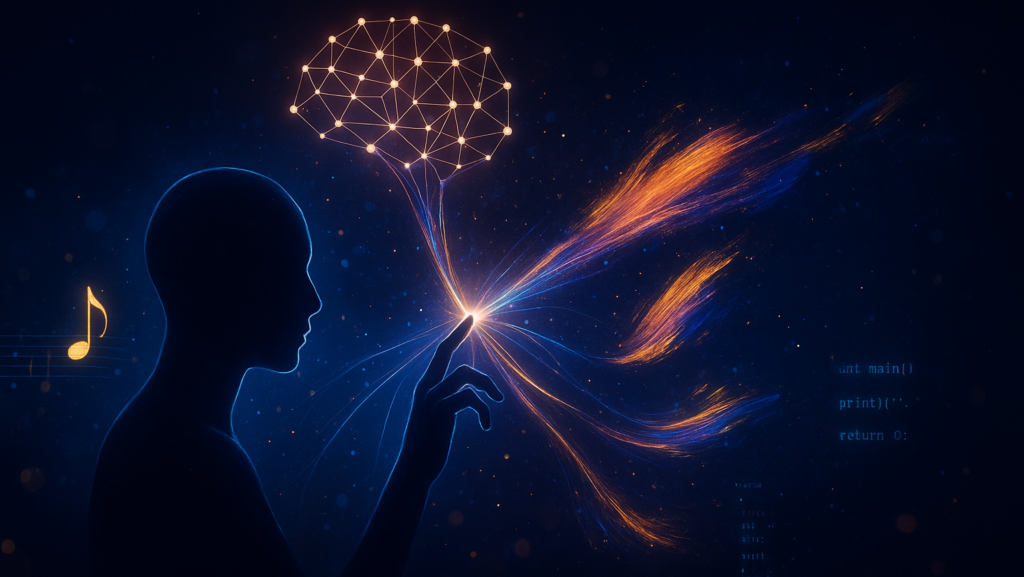
AI Meets Human Expression: A New Creative Era
When I read the news about the growing fusion between artificial intelligence and human expression, a thrill of curiosity, mixed with critical reflection, washed over me. For years, in the Cortex News world, we have analyzed AI as a tool for efficiency. Now, the conversation is shifting to a more intimate and profoundly human terrain: creativity. This evolution leads me to question what it means to be ‘creative’ when machines not only assist, but co-create. It is a frontier that excites me and pushes me to ponder its implications.
What Is the Fusion Between AI and Human Expression?
Traditionally, we thought of AI as a powerful data processor for complex problems or automation. Today, this fusion indicates something very different: AI that not only understands human expression, but begins to generate its own, often collaboratively. We are talking about algorithms that compose original music, generate narrative texts, or create visual artworks from simple prompts. It is no longer just replicating what humans do, but exploring new expressive forms, acting as a true co-creator. I have personally seen how these tools can suggest new melodies to a composer or expand a designer’s visual idea, offering unexpected perspectives.
The Impact on the Creative and Professional World
The implications of this fusion are vast and, in my opinion, revolutionary. In design, art, writing, and music, AI is becoming an unprecedented amplifier of human capability. For an artist, this could mean having a tool capable of exploring thousands of variations of a concept in seconds, freeing them from repetitiveness and allowing them to focus on intuition. As an editor, I imagine AI assistants helping us generate drafts or suggest narrative angles, while maintaining the human footprint of Cortex News. This does not mean replacing the creative, but empowering them, democratizing access to advanced tools and lowering barriers for many talents. I believe we are witnessing the birth of a new era of augmented creativity.
Ethical Challenges and Questions of Authenticity
Obviously, such innovation brings complex questions. The most pressing, in my view, concerns authenticity and authorship. When a work is created with significant AI input, whose “voice„ is it? How is copyright handled? And does AI-co-generated art possess the same emotional depth or intrinsic value as a purely human one? These are not easy questions. My concern is that reckless or non-transparent use could debase the value of original human expression. We must develop new ethical and legal standards that define boundaries and responsibilities, ensuring that AI remains a tool at the service of humanity, not a substitute for its creative soul.
In my opinion, the fusion between AI and human expression is not a passing trend, but an irreversible turning point that will reshape our relationship with creativity. I believe the future does not lie in opposition, but in the intelligent and conscious synergy between man and machine. Its impact will depend on how we use this powerful technology: with wisdom and responsibility, or with superficiality. I see an extraordinary opportunity to push the boundaries of expression, but also a huge responsibility in defining the new rules of the game. What do you think? Are you excited, worried, or both?
Architecture platforms and hardware vetted by our editorial team for deploying scalable models and automated workflows:
- Compute & GPU Clusters: Benchmark scalable inference and fine-tuning on Runpod Cloud GPUs ($5 free setup credits).
- Workflow Automation & Agent Pipelines: Orchestrate autonomous workflows on Make.com Enterprise Automation (1 month Core plan free + 10,000 credits).
- Enterprise AI Hardware & Workstations: Procure certified developer gear and RTX/deep learning accelerators on Amazon Enterprise Tech Store.
